Showing posts with label basketball. Show all posts

Tuesday, October 22, 2013

Lithuania's Honorary Consuls: Dennis Garrison

Another installment in our series profiling Lithuania's Honorary Consuls in the United States. Thanks to Aiste Zalepuga who conducted the interviews with each Consul and collected additional materials. 

Dennis Garrison is Lithuania's Honorary Consul in San Francisco. He received his undergraduate education from Illinois Wesleyan University and his graduate degree in business from Illinois State University. Formerly a Certified Public Accountant and college professor, he has worked in the  Sports Club business for the past 33 years.

San Francisco, California is the fourth most populous city in the state and the fourteenth most populous in the United States. Today, it ranks within the top 35 tourist destinations in the world. The large area around San Francisco is also the center of technological innovation and venture capital, including Silicon Valley, home to the world's largest technology companies and thousands of small startups. It is the leader in high-tech innovation and development, responsible for thirty-three percent of venture capital investment in the United States. Moreover, the surrounding area includes some of the world's most highly regarded universities, including Stanford and the University of California at Berkeley, both of which are renowned research centers, which produce highly qualified graduates in technology, medicine, law and business.

A moderately sized Lithuanian community also exists within Northern California, and as Lithuania's Honorary Consul to the region, it is Dennis Garrison's job to promote Lithuanian social and artistic events there. "Right now, we have a growing Saturday Lithuanian language club for children and adults," he informed us. "Opportunities for education, research, and employment are also outstanding. Certainly, this is the best area in the world for innovation in technology related fields. While opportunities for exporting Lithuanian products here are limited, the exchange of ideas and technologies for the development of new products and jobs in Lithuania are available."

Garrison first visited Lithuania in 2001 to assist in the development of the Forum Palace in Vilnius. While there, he traveled to a variety of schools in the country's rural areas and helped to establish summer programs for the children. "My wife and I have developed friendships with over twenty children that we stay in contact with and support whenever we can," he said. "We have hosted Lithuanian college students in our home and traveled to Lithuania often. We have friends in most major cities and many small towns."

Honorary Consul Dennis Garrison and wife, Sally, at a summer camp in Dubingiai, Lithuania
In San Francisco, he works to ensure proper representation of Lithuanian culture. As Honorary Consul, he is also a member of the Consular Corps. In other words, he is responsible for helping to support the Embassy in Washington, DC, the General Consuls in Chicago and New York, and the other Honorary Consuls in the United States, Mexico, and Canada. Often, Garrison finds himself as a liaison between Lithuanian government official and business delegations who visit San Francisco and the Silicon Valley. On a daily basis, his duties range from assisting Lithuanians with any passport issues they may encounter whilst in the United States to researching Americans' relatives and ancestors in and from Lithuania.  "Certainly, I also make an effort to recognize the accomplishments of Lithuanians in athletics, especially basketball," he adds.

Tuesday, October 2, 2012

"The Other Dream Team"


On Thursday, Sept. 20, I was given the opportunity to attend a red carpet premiere of a documentary featuring the athletes pictured above. They were "the Other Dream Team" - a free-spirited and incredibly talented group of then-young men from Lithuania who triumphed, in their own way, at the 1992 Summer Olympics in Barcelona. Their emotional story of success is one that I had never heard before, maybe due to my failure to follow world events that year (born: 1991). If this national basketball team was new to me, perhaps it is also new to you. So this post is dedicated to them, and to the young country whose heart these men carried in their pockets that summer. The documentary, with the same title as this post, captures the events leading up to, surrounding, and following the 1992 Olympics far better than I could (of course), and you should all watch the film. That being said, I will do my best to paint you a picture.

In 1988, the Soviet Union competed in their last Summer Olympics. With a team of twelve, consisting of 4 Lithuanians, 3 Ukrainians, 1 Estonian, 1 Latvian, 1 Uzbek, and only 2 Russians, the Soviet team conquered the Olympic men's basketball tournament. They defeated the United States in semi-final play, 82-76, defeated Yugoslavia in the final, and clenched their second-ever gold medal in men's basketball. Ten members of the team, from Soviet-occupied nations, were compelled to play for a regime which had oppressed their people and their homeland since well before they were born. While they were undoubtedly proud of their talent and teamwork, it must have been with mixed emotions that they stood on the medal stand, before the world, and paid tribute to the national anthem of the Soviet Union. In their hearts, maybe they each paid tribute to their own country instead, dreaming of a day when they could glorify their own free people. For the four Lithuanians the road would be hard, but they would not have to wait long.

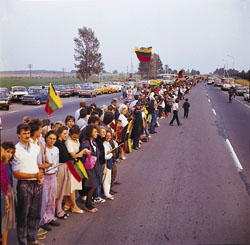
So here comes the crash course in Lithuanian independence. As you may know, the policies of Gorbachev (glasnost and perestroika), sent deep tremors though the foundations of the Soviet regime in the late 1980s. In 1987, the first non-criminal political protests took place in Vilnius, the Lithuanian capital, and by 1988 huge rallies led by Lithuanian citizen groups were demanding radical reform. That year, one of the stars of the 1988 Olympics Soviet team, Sarunas Marciulionis, was allowed to be drafted by the Golden State Warriors and become the first European with a regular slot in the NBA. In 1989, Pro-independence groups organized a massive human chain connecting the three Baltic capitals (Vilnius, Riga, and Tallinn), in which two million Baltic people took a place on the line. Over 25 percent of the entire regional population joined hands in a message of independence in one amazing and powerful moment.


In 1990, Lithuania was permitted to hold free democratic elections, and you can guess the result. In the new parliament's first session, the Supreme Soviet of the Lithuanian SSR became the Supreme Council of the Republic of Lithuania, and Lithuanian independence was formally declared. After a few violent interjections by a withering Soviet government, Lithuania was formally recognized as an independent state by the international community and admitted into the United Nations in September 1991.

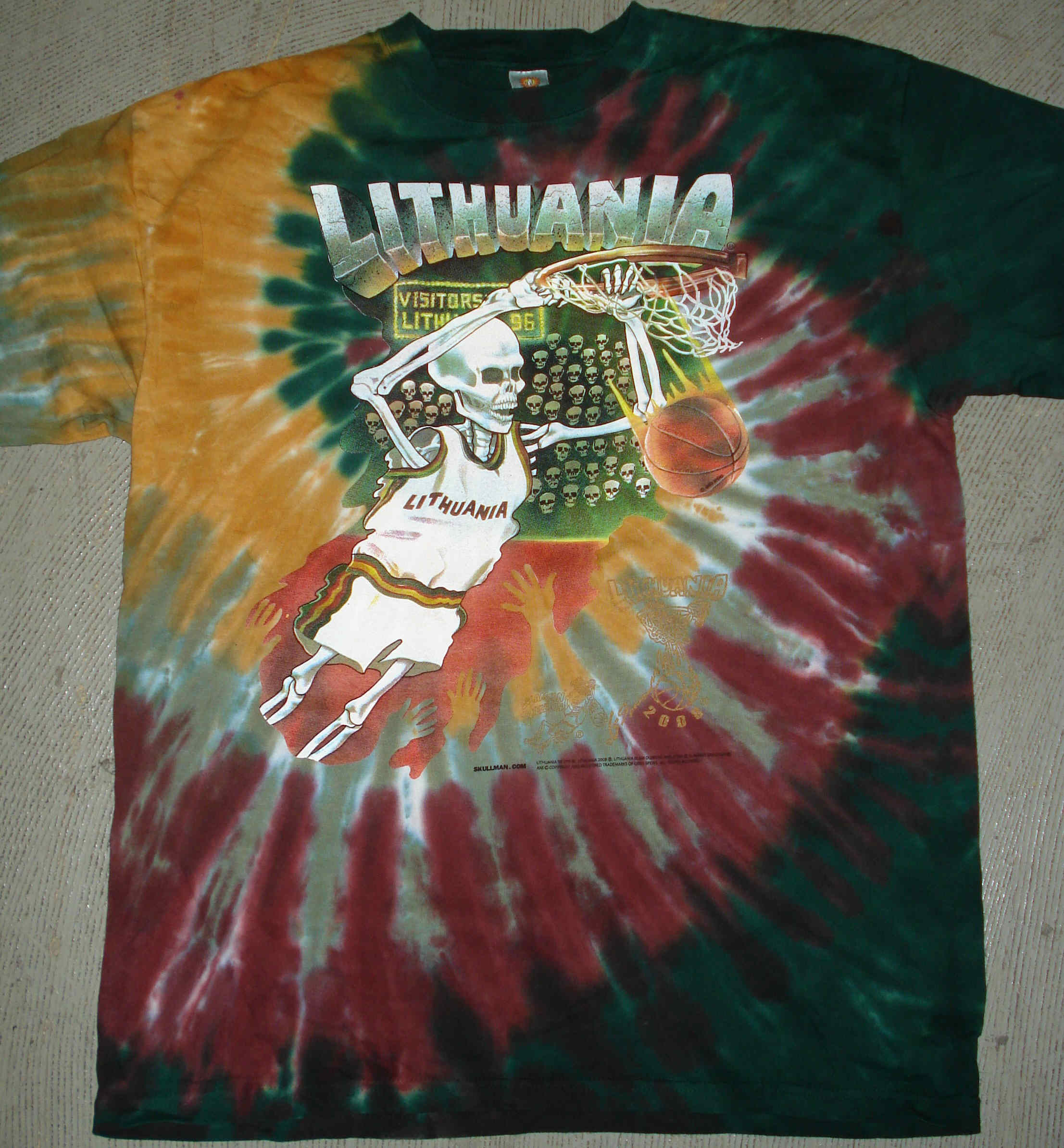
The Republic of Lithuania, having not officially existed since 1940, was now a free and democratic country - and it was completely broke. The new capitalist economy was struggling, and there was simply no money for a competitive national basketball team. The four star Lithuanian players of the 1988 Soviet gold-medal run were ready to play again - but they needed jerseys, travel money, and the basic funds to pay tournament entrance fees. Marciulionis, still in the USA playing for Golden State, began raising money on his own, a few hundred dollars at a time, by making appearances at private gatherings in the Bay Area. When a local newspaper published a story on his quest however, his fundraising days were over. The team's salvation came from some of the most unlikely and memorable investors the game of basketball ever had - the bandmembers of "The Grateful Dead". Huge basketball fans themselves, they jumped at the opportunity to sponsor a team of their own; not just any team, but the first basketball team of the free nation of Lithuania, who defied the Soviets and struck out on their own. Soon Marciulionis was headed back to his homeland with a check, handed to him backstage of a Grateful Dead concert, to enter the qualifying tournament of the 1992 Summer Olympics. The team's new warm-ups would appear in the mail soon after. (see below)


Four years after donning the red uniform, the Lithuanians were back in the Olympics wearing their own green, red, and yellow jerseys. Led by basketball phenomena Markevicius and Arvydas Sabonis, the upstart team made a Cinderella run to the semi-final round, where they faced arguably the greatest basketball team ever assembled - the United States "Dream Team". Michael Jordan, Magic Johnson, Karl Malone, Charles Barkley, Patrick Ewing, Larry Bird, and several other all-star professional players had recently won the right to participate in the Olympics (and the rest of the world didn't stand a chance). "The Other Dream Team" lost to the "Dream Team", 76-127. After the game, the guys from Lithuania were too busy shaking hands with their basketball heroes to worry too much about the score. They had a good run after all, and ahead of them was still the most influential game of their lives.

In the Bronze medal round the Lithuanians faced their old Soviet familiars, operating under the title of the "Commonwealth of Independent States" (CIS). They had faced-off in the preliminary round and the CIS had won, but now the stakes were infinitely higher. For the new nation it was way more than a basketball game or an Olympic medal. It was more than a chance to validate themselves on the world stage. The game was chance for Lithuania to cast out the demons of their troubled past. As the Lithuanian president watched and screamed from the sidelines, and millions around the world screamed beside him, the teams waged war for four quarters. Lithuania was only just ahead 82-78 when the buzzer rang, and they held their heads in joy and disbelief. On the medal stand, a strong contrast could be made between the stoic American Dream Team and "those other guys". The Lithuanians took their time making a way to their platform, too overwhelmed with emotion to maintain any semblance of order, wearing those iconic tie-dye warm-ups (which had become the must-buy item of the '92 Olympic Games). They wore those Bronze medals as true champions would, and the world cheered as a young country forged their new national identity.


The members of the Other Dream Team can still hear the roar of the crowd, and talking about that moment brought tears to the eyes of every single player interviewed for the documentary. A few members and contributors of the original team made an appearance for the premiere that I attended, and they took a stand in the crowded theater to face thunderous applause. The President of Lithuania was there as well, but somehow you could tell who the real superstars were (In part because they stood two feet over the rest of us). The occasion was simply another emotional and uplifting evening that I have shared with the people of Lithuania - listening to the amazing story of a humble basketball team that this country will never forget.